 |
Runes |
 |
I had a really great comparison chart of runes sent by Fionna O’Mull, but when I tried to copy it, you couldn’t read them (maybe they are magic!). The rune “alphabets” shown here are from Reading the Past: Runes, by R.I. Page (University of California Press/British Museum, 1987). The Roman letters given under each rune are approximate. For more information I highly recommend Page’s book which covers a variety of runic inscriptions from various cultures.
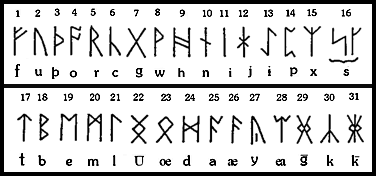 The Anglo-Saxon “futhork”.
From the 7th to the 9th centuries the number of runes was reduced and simplified. This began the divergence into two variant types: the “common” and the “short-twig” runes.
The Anglo-Saxon “futhork”.
From the 7th to the 9th centuries the number of runes was reduced and simplified. This began the divergence into two variant types: the “common” and the “short-twig” runes.
 The younger “futhark”: the Danish or “common” runes.
 The younger "futhark": the Swedo-Norwegian ro short-twig runes.
Previous Article |
Next Article |
Back to Early Period #15 index
Back to Early Period Index |
Back to PastTimes